


Gansk chooses fiberglass: repairable, lightweight and built to last outdoors for decades | JINHANFAIR DiscoverNEW
2026.07.22


Opening Gemini in 3 seconds...
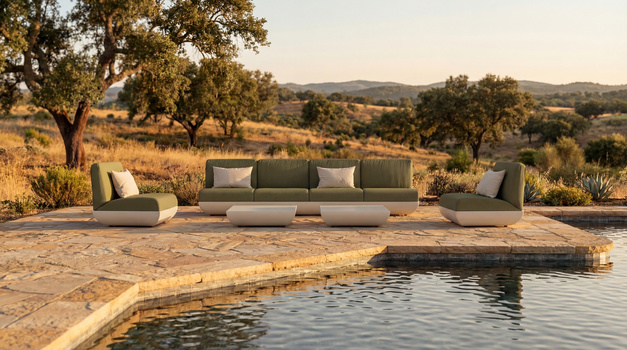
Fiberglass is more commonly associated with boat hulls than with garden furniture, but for the Portuguese brand Gansk, that overlap is precisely the point. Reinforced with resin, the material combines strength, low weight, and resistance to the elements, qualities long exploited in marine construction and now put to use in tables, chairs, and loungers designed to stay outdoors for decades.
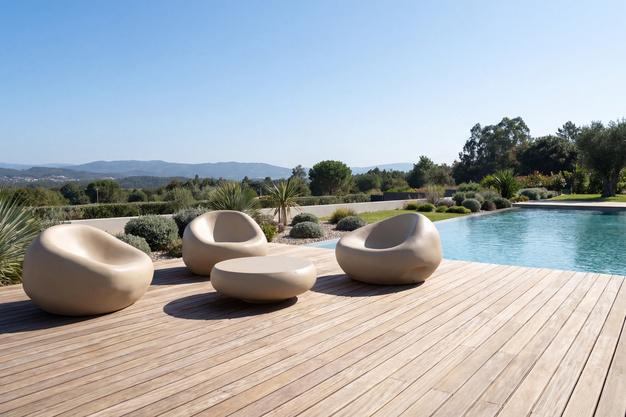
•From stone to fiberglass
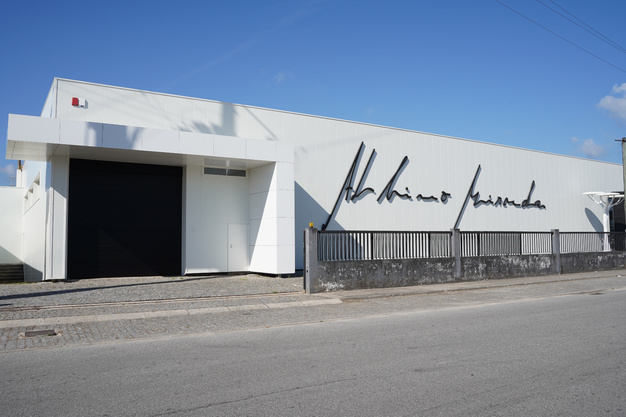
Gansk belongs to Albino Miranda, Lda., a family-run manufacturer founded in 1989 by artist and sculptor Albino Miranda. The company started out working with stone before Miranda, introduced to fiberglass by a friend, began experimenting with the material himself. That work led to Karpa, launched in 2009 as the group's first fiberglass furniture brand, known for combining fiberglass with stone, metal detailing, and decorative elements such as gold leaf, and aimed primarily at indoor, sculptural pieces.
Because fiberglass also suits outdoor and marine use, Miranda saw an opening for exterior furniture that didn't fit naturally within Karpa's ornate style. 'That's why he created another brand, Gansk,' says João Pereira, the company's sales manager. Gansk followed in 2015, positioned for buyers looking for design that is simpler and more accessible than Karpa's.

•A material built to last
Every Gansk piece is made from resin reinforced with fiberglass. Well-maintained, it can last between 25 and 30 years outdoors, and damage is straightforward to fix. 'If you break something, we can just apply another layer of resin and another layer of fiberglass, and it will be fixed. You don't need to throw the piece away,' João explains. That repairability, more than the raw material itself, is what the company points to when it talks about sustainability. 'The material itself is not a sustainable material, but the long-lasting and repairable properties make it sustainable in practice,' João notes.
Colour is where fiberglass shows its limits. The structure itself does not weaken under UV exposure, but finishes can fade over time, particularly darker shades, in much the same way car paint does. Lighter and matte colours hold up better outdoors, and refinishing after some years is uncomplicated. Climate makes little difference to how pieces are produced: the same paints and finishes go into furniture bound for rainy Britain as for drier Iberian markets.
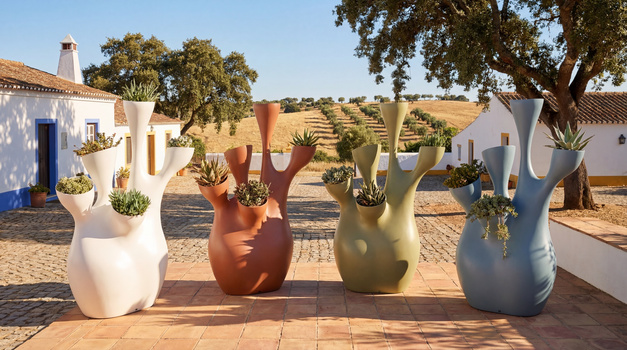
•Working directly with architects and hotels
Gansk sells without official distributors, working instead directly with architects, interior designers, and hospitality or large residential projects. Involvement typically begins early, while a project is still being designed. 'We start developing the project very early, so we can propose things,' says João, pointing out that fiberglass remains an unfamiliar material to many designers. 'People don't know what can be done with it, but we do, and we help as much as we can.' That collaborative approach regularly produces bespoke pieces built for a specific space rather than pulled from a standard catalogue, and it is also central to the company's stated design philosophy: combining modern, elegant lines with the organic, sculptural forms rooted in Miranda's background as a sculptor.
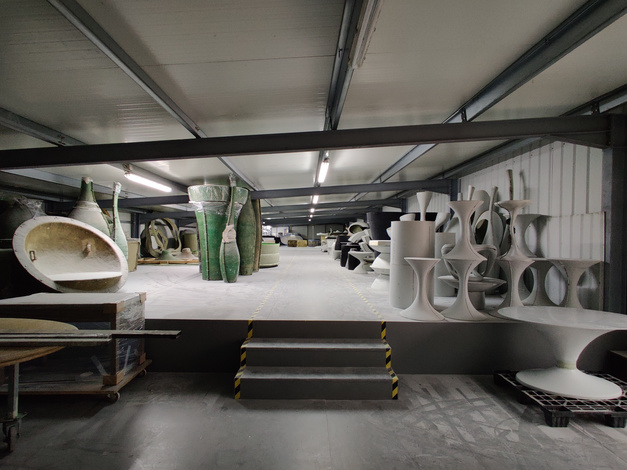
•Markets split by style
Sales concentrate close to home. Portugal and Spain remain Gansk's largest markets, followed by the United Kingdom and the United States, though the two brands perform differently abroad. The UK leans toward Karpa's more decorative style, while demand in the US is broader, one reason the group maintains both brands rather than merging them.
Other markets have shifted for reasons outside the company's control. Russia, once significant for Karpa, has produced no sales in four years because of the war in Ukraine, and Middle Eastern demand, historically strong for Karpa as well, is currently described as being on standby. The Netherlands, by contrast, has grown into a solid market this year. Scandinavia, Benelux, and Germany remain limited territory, largely because Scandinavian taste runs toward minimalism, a style that historically sat uneasily next to Karpa's more elaborate output, even though Gansk's own outdoor line is fairly minimalist and has found modest, still small-scale, success in Denmark and Sweden.
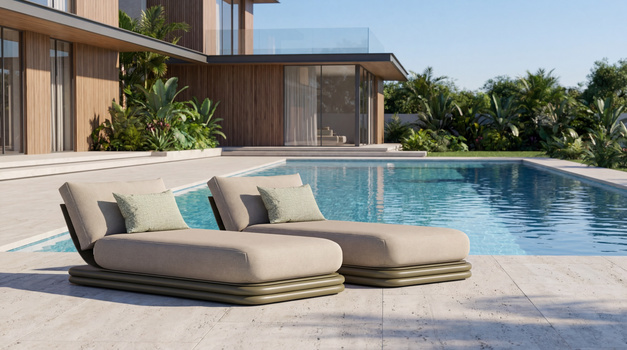
•Expanding the palette
A recent rebrand widened Gansk's aesthetic range considerably. The palette used to lean on cool tones, blues, greys, blacks, and whites; it now spans a much fuller spectrum, including custom RAL and NCS colours. Fabric options grew from six standard choices to more than sixty, all sourced from Sunbrella, the brand's exclusive textile partner. 'It's the only brand that we feel comfortable with,' João says, citing its durability and resistance to mould, mildew, and colour loss. The acrylic-fibre fabric can be cleaned with bleach or a pressure washer without damage.
•Customisation as the real advantage
Where competitors often rely on roto-moulded plastics, fixed to the dimensions of a given mould, Gansk's handcrafted process allows pieces to be cut, extended, shortened, or resized well beyond their original form. Repairs stay simple for the same reason. Design responsibility currently rests with Miranda alone, though the company is weighing whether to bring in outside designers in future. His sons help run daily operations: Vasco as sales director, Luis overseeing production.
•Trust, price, and a growing US push
With around thirty people in production, most of them artisans working by hand, output stays deliberately limited, and skilled labour is hard to find, requiring higher wages and ongoing training of younger staff. Prices sit at the high end, and closing a sale often depends on a client seeing a piece in person first. 'They have to trust us,' João says, which is why trade fairs and a showroom near the factory, currently being renovated, matter as much as the product photography itself.
The clearest growth opportunity lies in the United States, already a strong market despite the absence of a dedicated showroom. Talks are underway with American partners, with an initial placement of ten to fifteen pieces possible somewhere on the East Coast, potentially Miami. Resin prices, tied to fuel costs, have pushed prices up by roughly three to five percent most years, a pattern likely to continue as the company pursues that expansion while keeping production anchored to its Portuguese workshop.
About JINHAN FAIR
JINHAN FAIR for Home & Gifts(Poly Spring/Autumn Fair Phase Ⅱ) is a leading international trade platform organized by Poly Exhibition. Established in 2000, JINHAN FAIR has been successfully held for 53 editions and is recognized as one of China's most established sourcing fairs for the home and gifts industry. JINHAN FAIR is also the only Union of international Fairs-approved export trade fair in the home & gifts sector in China.

The 54th Jinhan Fair
Jinhan Fair Online Exhibition

Recommended
-
Buyer Services at the 54th JINHAN FAIR | Buyers Guide
-
New Highlights at The 54th JINHAN FAIR丨Buyer’s Guide
-
 C&F Enterprises: 50 Years of Design Across Home & Gift
-
 Chaozhou In Color Ceramic: From a 50,000-Square-Meter Factory to Global Flower Pot Markets
-
 Rojemac: A Brazilian Home & Lifestyle Buyer with 20+ Visits to JINHAN FAIR


 Visitor Registration
 Booth Application